Buttonbush: A Wet-Site Shrub for Pollinators
Buttonbush loves wet soil and feeds pollinators and ducks, but it dislikes drought and its bark is listed as toxic. What seven extension and state sources say.
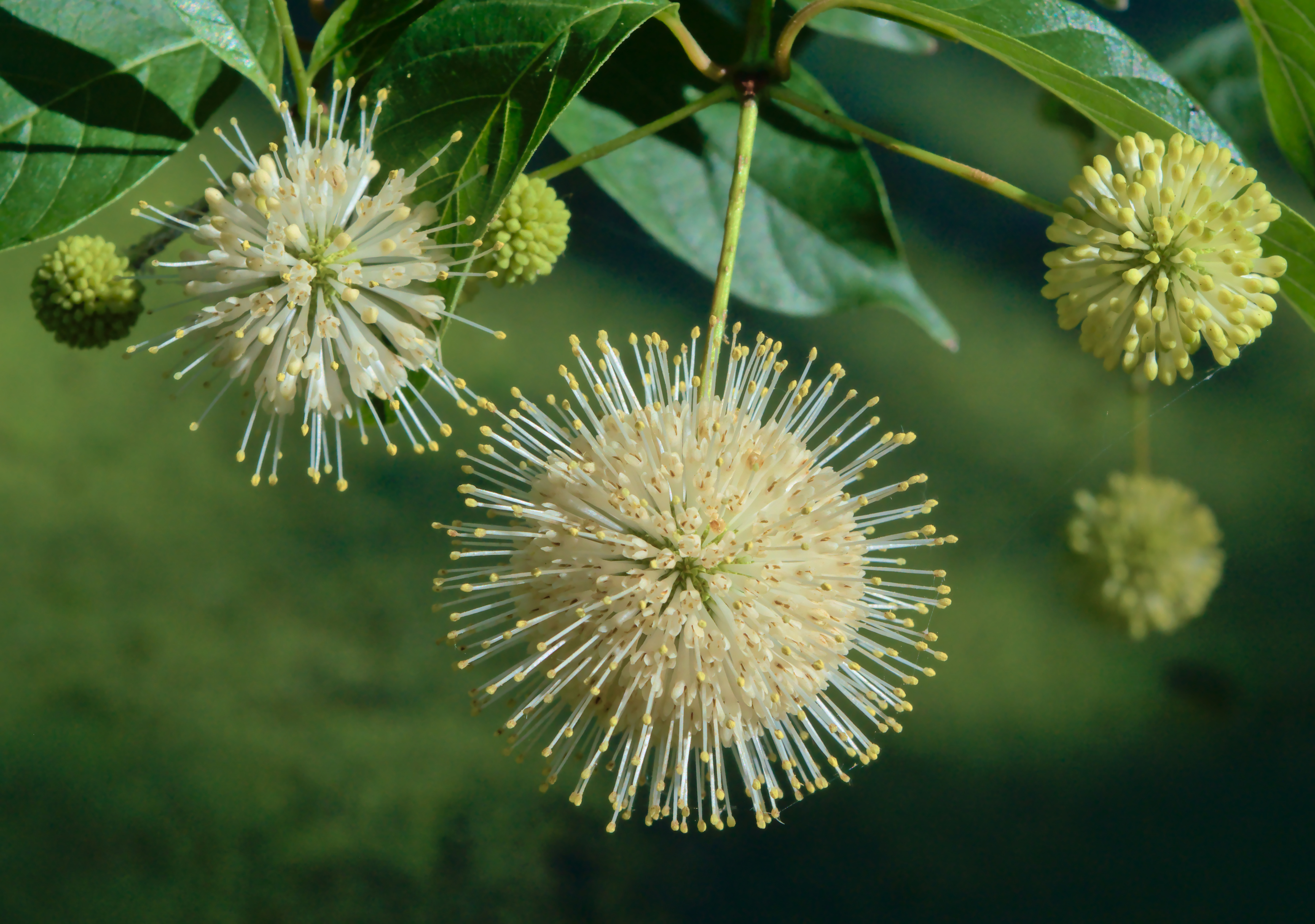

Buttonbush (Cephalanthus occidentalis) is a native shrub that grows by swamps, streams and ponds. Its round white flower balls look like pincushions, and pollinators love them. It needs wet soil, and one source lists its bark as toxic. This article uses seven sources: the North Carolina Extension Gardener Plant Toolbox, Clemson HGIC factsheet 1098 (2020), the University of Illinois Extension shrub selector, Oklahoma State University's Oklahoma Proven profile, a Mississippi State University Extension publication on buttonbush in ponds, the West Virginia Division of Natural Resources (WVDNR) and the Morton Arboretum. The Mississippi State publication treats the plant as a pond weed, which is a different point of view from the garden sources. The Illinois, Oklahoma and WVDNR pages are short summaries.
Safety: bark and horses
NCSU says the plant has low severity poison characteristics, and its problems list includes a problem for horses. NCSU says the toxin is found in the bark, and that eating the bark can cause vomiting, convulsions and paralysis. It names the toxic principle as cephalathin, spelled that way in the page. No other source we read says anything about toxicity, and none covers children or dogs and cats. Our own advice, not from the sources: do not let anyone chew the bark or twigs, and keep horses away from the shrub. NCSU itself recommends the plant for a children's garden, which sits uneasily next to the bark warning, so we treat this as an open question for families with young children and pets. Mississippi State also lists chemical options for killing buttonbush in ponds. We do not repeat product names or mixes. The label of any product is the rule.
Where it grows
- Water: all sources say wet to moist soil. NCSU says consistently moist to wet, rich soil, and standing water up to 3 feet. Illinois says it must have moist soils and can grow along the water's edge. Clemson says it cannot tolerate drought, and supplemental watering is needed in full sun spots that dry out. Morton says it is moderately sensitive to drought. Oklahoma says it does not like very dry soil.
- Light: full sun to part shade (NCSU, Oklahoma, Morton). NCSU says flowering is poor in shade or dry soil.
- Other tolerances: heat and soil compaction (NCSU, Oklahoma), alkaline soil and wet sites (Illinois, Morton). WVDNR says wet to moist, acid to neutral soil.
- Hardiness: Clemson and Illinois say zones 5 to 11, Oklahoma says zones 5 to 9, and Morton says zones 4 to 8.
Size and form
The size ranges differ. NCSU says usually a small shrub up to 12 feet tall and 8 feet wide, but it can grow as a tree up to 20 feet. Clemson says 6 to 8 feet tall and wide, sometimes 12 to 15 feet. Illinois says 6 to 12 feet tall and 6 to 15 feet wide, shorter in the north. Oklahoma says 5 to 12 feet tall and 4 to 8 feet wide. WVDNR says 3 to 9 feet. Morton says 6 to 12 feet high and 12 to 18 feet wide. Mississippi State says it can reach 45 feet with trunks up to 1 foot across, though it is normally relatively small. Clemson calls the form open and irregular, described by some as disheveled, and says it is a fast-growing, short-lived shrub that spreads by suckering into thickets. WVDNR says it is short lived, loses its form after a few years and must be cut back to resprout, while Morton says it is often long-lived, so the sources disagree.
Flowers and fruit
Flowers appear from June to August or September in 1 to 1.5 inch balls (NCSU, Clemson, WVDNR). NCSU says the fruits are reddish-brown and persist into winter. Clemson says each flower lasts up to 4 days, and nutlets mature from August to November. Clemson says buttonbush is one of the last native shrubs to leaf out in spring, and that fall color is insignificant to mottled brown and yellow. Clemson says it was introduced commercially in 1735, mainly for beekeepers.
Wildlife
NCSU calls the wildlife benefits exceptional, with pollinators, waterfowl, songbirds and mammals, and says deer resistance is moderate. Clemson says the leaves feed the larvae of the showy hydrangea sphinx and titan sphinx moths, and the nutlets are eaten by waterfowl. Oklahoma says flowers attract hummingbirds, bees and butterflies, and that it is a good honey plant. WVDNR says deer browse the foliage and twigs and ducks, especially mallards, eat the seeds. Morton says it attracts more than 24 species of birds and tiger swallowtails. Mississippi State says birds often nest in it, and that it can interfere with pond access, so be prepared to control unwanted expansion.
Care and pruning
NCSU says it needs little pruning and has no significant problems. Clemson says to prune lanky branches back to outward growing side shoots, or limb it up as a small multi-trunk tree, and to rejuvenate an unruly plant by cutting it close to the base in early spring before new growth. Morton says to prune in the dormant season or early spring. Clemson says there are no serious insect or disease problems, and NCSU says no significant problems. Illinois lists drought and drowning and edema as environmental problems.
Cultivars
Clemson lists 'Bailoptics' (Fiber Optics, 5 to 6 feet), 'Bieberich' (Sputnik, 10 to 15 feet, pale pink flowers), 'Keystone' (8 to 12 feet, a USDA NRCS and Pennsylvania Game Commission introduction from northeastern populations), 'Kolmoon' (Magical Moonlight, 5 to 8 feet), 'Select A Dark Green' (Ping Pong, about 8 feet) and 'SMCOSS' (Sugar Shack, 3 to 4 feet). Oklahoma lists Sugar Shack at 3 to 4 feet with red fruit. NCSU says a dwarf cultivar does well in the same conditions.
Where we are less certain
The sources disagree on size and on how long the plant lives. Toxicity is reported by only one source, and the severity and which animals are at risk is not well described. We found no source on how much bark causes harm. The Mississippi State publication is about ponds in that state, not gardens.
Sources
- North Carolina Extension Gardener Plant Toolbox, Cephalanthus occidentalis: https://plants.ces.ncsu.edu/plants/cephalanthus-occidentalis/
- Clemson HGIC, Common Buttonbush (HGIC 1098, 2020): https://hgic.clemson.edu/factsheet/common-buttonbush/
- University of Illinois Extension, Buttonbush: https://web.extension.illinois.edu/shrubselector/detail_plant.cfm?PlantID=333
- Oklahoma State University, Buttonbush (Oklahoma Proven): https://extension.okstate.edu/programs/oklahoma-proven/plant-profiles/cephalanthus-occidentalis-buttonbush
- Mississippi State University Extension, Buttonbush: https://extension.msstate.edu/publications/buttonbush-cephalanthus-occidentalis
- WVDNR, Buttonbush: https://wvdnr.gov/outdoor-recreation/plants-fungi/buttonbush/
- The Morton Arboretum, Buttonbush: https://mortonarb.org/plant-and-protect/trees-and-plants/buttonbush/