Cardoon: A Bold Edible Thistle With a Weed Risk
Cardoon is a spiny silver-leaved relative of the artichoke grown for blanched stalks and looks. What four sources say about climate, blanching, spines and invasiveness.
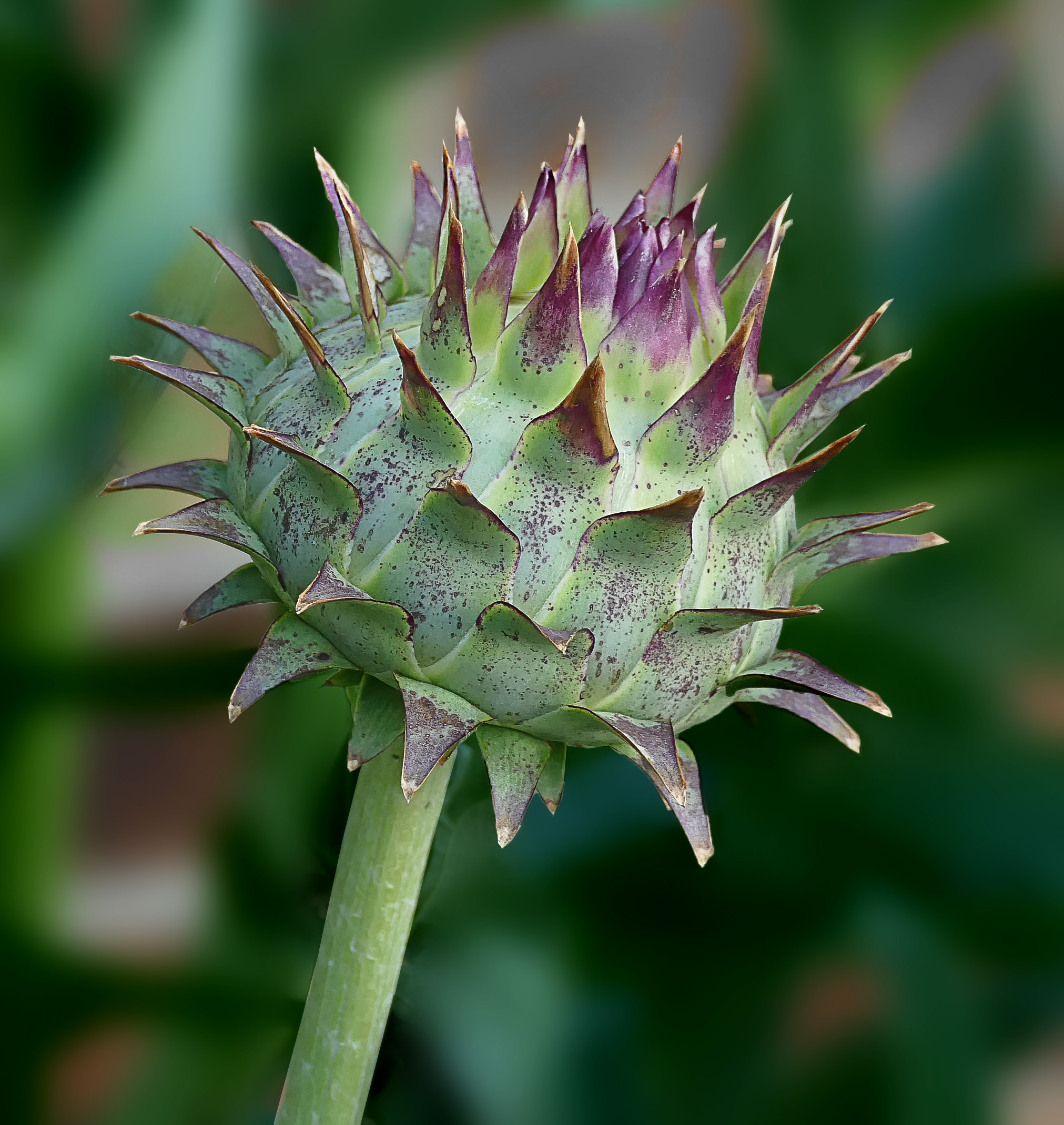

Cardoon (Cynara cardunculus) is a large, spiny, silvery perennial thistle that is close kin to the globe artichoke. People grow it for the look of the leaves and, in some places, for the blanched leaf stalks. This article uses four sources: the University of Wisconsin Extension horticulture page (revised July 2026), the North Carolina State University Plant Toolbox, the California Invasive Plant Council (Cal-IPC) profile, and Oregon State University's Oregon Vegetables page (last revised 2010, written for commercial growers).
Safety and cautions
The leaves carry spines. Wisconsin says heavy yellow spines edge the leaves, especially along the leaf stalks, and NCSU tells readers to be mindful of the spines along the stem. Spineless varieties exist. None of the four sources covers pets, allergy or how much is safe to eat, so we cannot say. NCSU says the flowers are edible but not as good for eating as globe artichokes, and that the young, emerging leaf stalks are the part that is blanched, cooked and eaten. If you are not sure that a plant is cardoon, do not eat it (our own caution, not from the sources). Several sources discuss weed control. We do not repeat any product or rate. Follow your local rules and the label of any product.
The weed risk comes first
Cal-IPC lists the plant, which it calls artichoke thistle, as found below 500 meters elevation across California, in disturbed open sites, grassland, chaparral, coastal scrub and riparian areas. It reproduces by seed and sometimes resprouts from root fragments. It says the plant hybridizes frequently with cultivated artichoke and is sometimes sold as an ornamental. Cal-IPC's rating on that page is shown with a question mark ("Moderate?"). Wisconsin says it has become naturalized and is considered a weed in mild climates including Argentina, Chile, Australia and California, but is not a concern in cold-winter areas. NCSU says it is considered invasive in North Carolina and in places such as California forms colonies. Oregon State says it is a nuisance weed in parts of Northern California because it makes hundreds of seeds that travel on the wind. Cal-IPC and NCSU both say that if you remove it by hand you must take out most of the large taproot to avoid resprouting. Before you plant it, check whether it is listed as invasive where you live.
What it looks like
Wisconsin describes a fast-growing, tender perennial in the aster family, native to the western and central Mediterranean and domesticated in ancient times. In the first year it forms a big urn-shaped rosette. Leaves emerge silver, become grey-green, and reach up to 3 feet long. In the second season it makes thistle-like flower heads about 2 inches across, violet-purple, which bees and other pollinators visit. Wisconsin says plants generally do not bloom in colder climates because the growing season is too short. Under good conditions plants can reach 3 to 4 feet tall and 4 to 5 feet wide in one season, so they need room. NCSU says the above-ground part dies back each year and regrows from a large, deep taproot, and that it may go dormant in hot summers.
Climate
The sources differ in tone here. Wisconsin gives hardiness as zones 7a to 10b and says it is treated as an annual in cold climates. NCSU says it grows as a perennial where summers are cool and winters mild, and is often grown as a half-hardy annual. Oregon State says it does best in a frost-free coastal area with cool foggy summers, and that it is sensitive to frost. It also says cardoon grown in hot conditions will be inedible because of strong bitter compounds. That last point is from a commercial page, but it fits NCSU's note about dormancy in heat.
Site and soil
Wisconsin says full sun, well-drained soil, and a site protected from strong winds. NCSU says rich, well-drained but moist soil. Oregon State says a wide range of soils work but deep, fertile, well-drained soil is best, the plant is deep rooted, and steady, uniform growth matters for quality. It says leaves and stalks become pithy under water stress and gives about 10 to 12 inches of water spread evenly through the season for commercial production. We would treat that as a commercial figure, not a home garden rule. Wisconsin says it can be grown in a container, but the container must be very large. NCSU says mulch heavily to help winter survival.
Starting plants
Wisconsin says to sow seed indoors 6 to 8 weeks before the last frost and transplant after the danger of frost. Oregon State says transplants set out in spring give the best production, direct seeding is possible, and plants can also be propagated from stem pieces or suckers. For the commercial method it describes planting into an 8 to 10 inch trench and adding soil as plants grow, with spacing of 18 to 24 inches. Wisconsin says to give plants plenty of room. It suggests snapping or cutting off floppy older leaves to keep a vase shape, because lying leaves can mat and smother neighbors.
Blanching and harvest
Oregon State says that as the leaves near maturity they are tied together near the top and the plant is wrapped in burlap, paper or other material to blanch the leaf stalks, which generally takes 4 to 5 weeks. Harvest starts 120 to 150 days after planting by cutting just below the crown and trimming away loose leaves, leaving a heart of 18 to 24 inches. It says hearts are seldom stored, and at 32 F with high humidity good ones keep 2 to 3 weeks. Wisconsin agrees that blanching uses a cloth, paper or cardboard covering to exclude sunlight for a few weeks before harvest, and notes that eating the stems would ruin the ornamental look. Wisconsin lists varieties, mostly from European catalogs: Bianco Avorio (110 days from transplant), Gobbo di Nizza (110 days), Porto Spineless (100 days, spineless, compact) and Rouge d'Alger (thornless). Oregon State says spineless types are preferred and named varieties are hard to find in US seed catalogs.
Overwintering
Wisconsin says gardeners in colder places may try cutting plants to about a foot tall, covering them with soil or compost, then with a bushel basket or rose cone, and draping a tarp to shed rain. Remove the cover after the snow melts and see if the plant survived. It does not promise success.
Problems
NCSU lists root rot, gray mold and powdery mildew, plus snails, slugs and aphids. Wisconsin says an annual crop has few pests, though Japanese beetle has been reported in the eastern US, and deer do not favor it.
Where we are less certain
No source covers pets, allergy or safe amounts. Oregon State's page is old and commercial, with fertilizer rates that we did not copy. The sources differ on whether to treat it as a perennial, and only local experience will tell how a plant overwinters in your garden. Whether it is a weed depends on your region.
Sources
- University of Wisconsin Extension Horticulture, Cardoon, Cynara cardunculus (revised July 2026): https://hort.extension.wisc.edu/articles/cardoon-cynara-cardunculus/
- NC State Extension Gardener Plant Toolbox, Cynara cardunculus: https://plants.ces.ncsu.edu/plants/cynara-cardunculus/
- California Invasive Plant Council, Cynara cardunculus profile: https://www.cal-ipc.org/plants/profile/cynara-cardunculus-profile/
- Oregon State University, Oregon Vegetables: Cardoon (2010, commercial): https://horticulture.oregonstate.edu/oregon-vegetables/cardoon-0